Web Hosting
WEB HOSTING
(with related terminologies)
- to host something on the web, you need web servers (thing that sends you your website when you type your website url)
- how the web works
types of web server technologies
- dedicated servers - Apache - Nginx
- cloud servers - AWS - Google Cloud
TODO: deploy something on each service
- how to setup and deploy server (both on Nginx and Cloud)
- how to connect an API
static and dynamic websites
- static - web server grabs files and returns them
- dynamic - web server runs programs to generate content and returns them
Apache vs Nginx
Apache
- 1 page web request = 1 process_thread (of the CPU)
- a forked threaded solution, or keep-alive, where one connection is opened for one user.
Nginx
- event drivenflask is NOT a webserver, but it includes one for local testing Gunicorn is a webserver
webserver workflow (with python)
Assuming 3 main technologies and your app
- Nginx - listens on port 80 for incoming HTTP requests from the internet
- Gunicorn - listens on another port (8000 usually) for HTTP requests from Nginx
- Flask/Django (your app) - configured with Gunicorn
- Database - some DB tech (Postgres/MySQL/GraphQL)
- someone makes a request to your web app (a browser / a bot)
- Nginx receives the HTTP request.
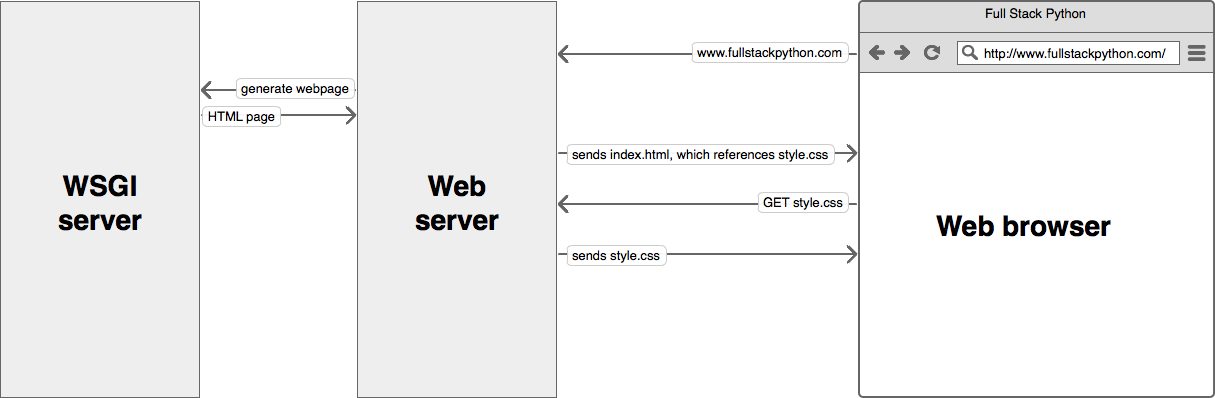
- If it is a static resource (css/js/images), Nginx serves it without bothering gunicorn.
- If it is a dynamic one, Nginx receives all the TCP packets belonging to the HTTP request efficiently, and then forwards the request to Gunicorn once the entire request is received. - this frees your Gunicorn provesses from handling slow clients.
- Gunicorn receives the request from Nginx, translates it into a Web Server Gateway Interface and calls the connected Flask/Django app (web framework)'s request handler method(which means calls a function from the app based on what you wrote in it)
- WSGI is a python-only thing. See CGI and FastFGI below
- The Web Framework (Flask/Django/others) implements business logic (does what it needs to do) and sends back a HTTP response.
- you can configure Gunicorn to make network calls to your database and other external services concurrently using non-blocking I/O so that the application can do the main thing while waiting on the socket for other requests.
- Gunicorn then returns the response to Nginx and Nginx sends the response to the client (the browser or bot)
default webservers (in Flask or Django) vs production webservers
When interfacing with the external world, you need to:
- handle slow clients
- tune the number of worker processes according to the number of available CPU cores and RAM
- incorporate asynchronous I/O using gevents
- other optimizations.
The default web servers provided by popular web frameworks like Django or Flask are optimized for development and perform poorly on production. (like Flask's test server)
So Nginx and Gunicorn make your Python web app production-ready.
on concurrency
- concurrency = two or more events or circumstances happening or existing at the same time
- http://www.aosabook.org/en/nginx.html
Why is high concurrency important for web servers?
- slow clients (ADSL/dialup connections/mobile)
To illustrate the problem with slow clients, imagine a simple Apache-based web server which produces a relatively short 100 KB response—a web page with text or an image. It can be merely a fraction of a second to generate or retrieve this page, but it takes 10 seconds to transmit over a 80 kbps connection to a client.
Essentially, the web server would relatively quickly pull 100 KB of content, and then it would be busy for 10 seconds slowly sending this content to the client before freeing its connection.
Now imagine that you have 1,000 simultaneously connected clients who have requested similar content. every client needs to be given memory to run their request. If only 1 MB of additional memory is allocated per client, it would result in 1000 MB (about 1 GB) of extra memory devoted to serving just 1000 clients 100 KB of content.
In reality, a typical web server based on Apache commonly allocates more than 1 MB of additional memory per connection, and regrettably tens of kbps is still often the effective speed of mobile communications.
- persistent connections (notifications, news and friend feeds, modern browsers that open 4-6 simultaneous connections to speed up loading)
With persistent connections the problem of handling concurrency is even more pronounced, because to avoid latency associated with establishing new HTTP connections, clients would stay connected, and for each connected client there's a certain amount of memory allocated by the web server.
Thus, the web server needs to scale nonlinearly with the growing number of simultaneous connections and requests per second. (linear scaling = 1MB per person x 1000 person = 1GB to transmit 100KB of content to everyone)
the LAMP stack
- components of a web application solution stack
- source
LAMP = Linux, Apache, MySQL, PHP
Many small scale web apps use this stack of technologies, but increasingly you'll see replacements for each of them being used instead. So let's look at them from a functional perspective and look at some possible alternatives as we go.
PHP is a programming language. Its job is to help a software developer explain the behaviour that the computer should exhibit in certain conditions. "When this happens, do this", "When the input is this, the output should be this", and so on. We write these things in programming languages, because we want to describe a sort of architecture of logic that the application must follow.
You don't need to write web applications in PHP, and in fact many web applications are not. It's limited in some respects, and some programmers just prefer other languages such as Java, Ruby, Perl, ASP, ColdFusion and many, many others. Almost all programming languages can be used to write web application software.
MySQL is a relational database system. It's where data that the PHP code needs is stored. This is where your details as a user are stored, your preferences, your orders and so on. PHP talks to MySQL and creates, retrieves, updates and destroys records in MySQL when you interact with the web application.
You don't need to use MySQL to store data, popular SQL alternatives include PostgreSQL or Oracle. In recent years there has been a rise in popularity of "NoSQL" systems like MongoDB and CouchDB. They all store - or "persist" as we prefer to call it - data for the web application, but have different features, strengths and weaknesses.
Apache is a web server program. Its job is to take HTTP requests from across the Internet, and say to PHP "hey, PHP, wake up, what do I do here?". PHP then looks at what is being sent, cookies sent by your browser and what it has been scripted to do, maybe talk to MySQL and then crafts a response in HTML and says "Here you go Apache, send them this HTML back", which comes back to your browser. Your browser then renders it, requests images and stylesheets and the like, and makes it look lovely on your screen.
There are alternatives to Apache. They include nginx, mongrel, IIS, Unicorn and others. They all do the same job: they take HTTP requests from browsers, and either figure out how to return a file or ask another program like PHP to return something back to the browser.
Linux is the operating system running all of these pieces of software. As an operating system it abstracts things that the programs need: the network stack, RAM, disc, etc. It helps some of the software create forked processes or threads and manages them so the writers of the software don't have to do that bit themselves. In essence, it goes some way to let writers of other software focus on solving the problems their software needs to solve rather than having to do all of that themselves from scratch.
Some people argue that Linux is the name of the kernel and the operating system is GNU/Linux. There are many GNU/Linux distributions you may have heard of: Redhat, CentOS, Ubuntu, Debian, Slackware, and so on.
There are alternatives that can be used including OS X and Windows but for various reasons these are less popular for web serving than Unix or Unix-like operating systems without graphical user interfaces.
In theory then you could replace each and every component. LAMP could be WNMJ (Windows Server + nginx + MongoDB + Java), but LAMP is popular because it's relatively easy to setup, well documented and easy to learn. It does pay dividends at the high-end to question each part of the equation though and wonder whether it's the best solution for the specific web application you have in mind.
CGI, FastCGI, WSGI (the thing in between web servers and you the client)
CGI
- User makes a request (e.g. clicks on something in the browser)
- web server CGI program (e.g. starts a Python Interpreter), feeds the request, then returns requestPrograms using CGI to communicate with their web server need to be started by the server for every request. So, every request starts a new Python interpreter – which takes some time to start up – thus making the whole interface only usable for low load situations.The upside of CGI is that it is simple – writing a Python program which uses CGI is a matter of about three lines of code. This simplicity comes at a price: it does very few things to help the developer.
FastCGI
- web server runs a long-running background process (the program)
- User makes a request and the webserver processes it through the already-running program
WSGI
- Some other programmer solves your CGI web programming problem.
- has plugins to do
- session management (same user, multiple http requests)
- compression (into gzip) to same server bandwidth
- SSL encryption
what is a WSGI?
- an extra layer in between your interface (browser) of your app and the web.
- mainly for generating dynamic webpages before putting it in the browser (because it seems there are many different settings needed for the app to change to make it work with different web servers. WSGI does them for you.)