Graph + relational databases
GRAPH + RELATIONAL DATABASES
TODO: many database tech
Types of Databases
- relational : MySQL, sqlite
- graph : Neo4j
- hierarchical : xml, json
- document : MongoDB
RDBMS vs MongoDB
<div class="container">
  <table class="table table-bordered" style="text-align:center;">
    <tbody>
      <tr>
        <th style="text-align:center;width:50%;">RDBMS</th>
        <th style="text-align:center;">MongoDB</th>
      </tr>
      <tr>
        <td>Database</td>
        <td>Database</td>
      </tr>
      <tr>
        <td>Table</td>
        <td>Collection</td>
      </tr>
      <tr>
        <td>Tuple/Row</td>
        <td>Document</td>
      </tr>
      <tr>
        <td>column</td>
        <td>Field</td>
      </tr>
      <tr>
        <td>Table Join</td>
        <td>Embedded Documents</td>
      </tr>
      <tr>
        <td>Primary Key</td>
        <td>Primary Key (Default key _id provided by mongodb itself)</td>
      </tr>
      <tr>
        <th colspan="2" style="text-align:center;">Database Server and Client</th>
      </tr>
      <tr>
        <td>Mysqld/Oracle</td>
        <td>mongod</td>
      </tr>
      <tr>
        <td>mysql/sqlplus</td>
        <td>mongo</td>
      </tr>
    </tbody>
  </table>
</div>
Relational Databases
- https://www.ntu.edu.sg/home/ehchua/programming/sql/MySQL_HowTo.html
- https://www.ntu.edu.sg/home/ehchua/programming/sql/MySQL_Beginner.html
- http://www.mysqltutorial.org/basic-mysql-tutorial.aspx
- https://www.elated.com/articles/mysql-for-absolute-beginners/
- a ledger style structure
- a THING is a row in a table
- sometimes you split up the THING into parts across different tables
relationships are made(setup) with Constraints
- the you use Foreign Key CONSTRAINTS to represent relationships between data
- by writing foreign keys, you give a row in some table an equal (or whatever) relationship to another row in the table (or another table)
- e.g. if you put a value in this column over here in this table and there isn't a corresponding value in this table over here, then it won't work.
- e.g. you may not be able to delete something here (in this row) because something is attached to it.
- by writing foreign keys, you give a row in some table an equal (or whatever) relationship to another row in the table (or another table)
- is rigid, limits the kinds of things you are allowed to put into the database
- can get complex (and rigid) when representing relationships
- relationships in the real world
- e.g. multilevel joins are terribly slow
- ORMs (Object Relational Mapping) is used to create complex queries
- relationships in the real world
- RDBMS are designed to answer known questions.
- they have to be built with all known questions in mind so that they can be designed into the ORM
Graph Databases
property graphs
do this first
- graphql + flask
- all graphql tutorials https://hackr.io/tutorials/learn-graphql
- a THING is a node or vertex
- nodes have PROPERTIES
- usually key-value pairs
{Keys: Values}
- usually key-value pairs
- nodes also have LABELS to tell you what type of thing it is
- example of a node:
n : Person
id : 1234
first_name : "Ed"
last_name : "Finkler"

where

n is the node label
other stuff are properties- nodes are connected together by RELATIONSHIPS or EDGES
- RELATIONSHIPS have a type and a direction and can have properties
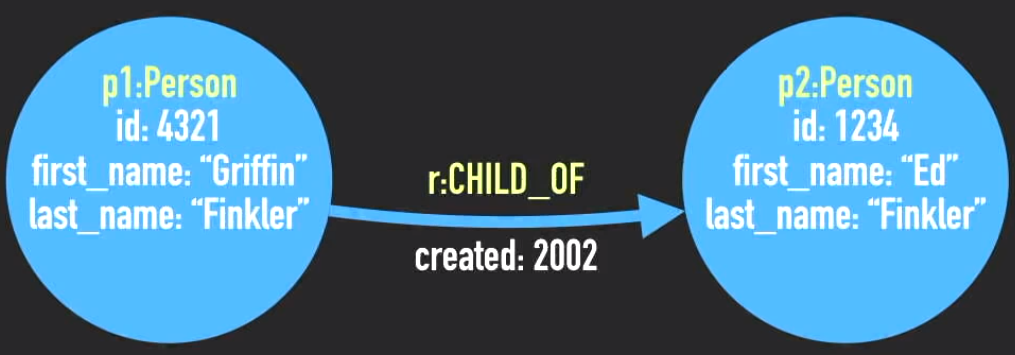
- above: setup of two nodes, both of them of type person
- they both have similar properties, but they don't have to
- there is a directional relationship between them (CHILD_OF)
in summary it's just DOTS/NODES and LINES/EDGES all the way down
- it more powerful than RDBMS specifically because the meaning is in the relationships
- direct relationships (but that's not hard to do with RDBMS)
- indirect relationships (which are harder to traverse with relational databases)
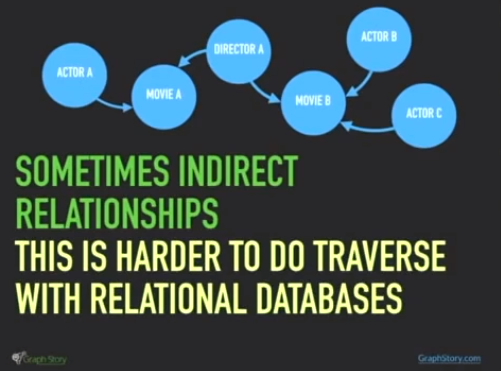
usually slow and non-performant on RDBMS
- questions you didn't expect (when designing the database, which is almost always)
- you can add more relationships as needed and still be performant